
Essay: False hopes and shattered expectations. How did the Russian federal elections go?
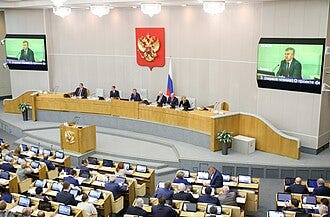
For the last half year, speakers, experts and Russian politicians in exile have talked about the State Duma elections as if it’s been a critical moment that could’ve defined the future. As if Russia hasn’t started a bloody war, and Putin hasn’t been killing and jailing his political opponents. It’s not a surprise who won these elections by a landslide.
The article political scientist Alexander Baunov wrote for the Carnegie Center in March started with “something in the air has changed”, and the next months indeed have been filled with hopes and expectations even though the State Duma doesn’t have much power now. Its own speaker, Boris Gryzlov, back in 2003 said that “Duma is not a place for debates”. It hasn’t been independent for years.
Thanks for reading Kontekst's Substack! Subscribe for free to receive new posts and support my work.
But now, even one anti-war and pro-democratic party, “Yabloko”, was allowed to run and had a terrific campaign, looking much stronger, more charismatic and decent than any other party on the ballot, with many young people supporting it on social media. Its previously unknown leader Nikolay Rybakov became a political star within a few days, and the election banners calling “For Peace” appeared on the streets, an unbelievable thing for an authoritarian regime in the middle of war.
But… it ended soon. After an eight-hour-long Kafka-like hearing in August, “Yabloko” was barred from running. The court found the party guilty of violating copyright law when, for example, “Yabloko” used the photo of Hiroshima after nuclear bombing without approval from the copyright holder, the US Army. Although “Yabloko” regional candidates kept their campaigns going, most prominent of them were banned as well.
Obviously, elections in Russia are neither fair nor just, and no one really expected that Putin would give up power as Viktor Orban in Hungary did earlier this year. But electoral autocracies usually prefer gentler tactics to stay in power over blatantly rigging the numbers. They limit airtime for the opposition, create spoiler parties that intend to steal votes from the real opposition or reduce turnout by making opposing people believe elections decide nothing.
United Russia (UR) got the most seats in history, taking 58 percent of votes, while even the state-controlled sociological institute said that, according to the exit polls, it’s around 49 percent, while data journalists estimate it to be at 34 percent. Only in one region, Novgorod Oblast, did anti-war “Yabloko” get to the regional parliament.
Of course, every party that was allowed to run officially supports the war. That’s a prerequisite in these elections. But some do it with a little less courage than UR, and generally any other party getting high numbers would at least have given hope that one day something might change. An argument for going to these elections was that this Duma might actually live to Putin’s death and then might have a chance to actually change something, to “open the window for opportunities”.
“Wait for the window of opportunity” has basically become the anthem of Russian opposition in recent years. Inability to do something is painful, so we calm ourselves with the idea that a black swan can fly in and open that window. Just as it happened with the USSR when nobody believed it could fall apart, until it did.
The tactic the Russian opposition suggested for this election is called “smart voting”, when, despite your political views, you vote for the candidate who is not from the ruling party and has the best chance of winning a seat. Smart voting already had modest success at the parliamentary elections in 2021, and the hopes were that it could get a few strong MPs into the Duma now. But it failed, mostly because of ruthless falsifications.
The thing about rigging elections is that it’s not just a brutal system that changes the genuine expression of people’s will. In Russia, polling stations are usually located at state-controlled institutions such as schools, universities or hospitals, so people working at these stations - the vicious State rigging the elections - are just teachers, doctors and professors. These people are usually the most oppressed and the most dependent on the state. They work many hours for a pittance, afraid of saying anything or going against the state, scared of losing the little they have. At the end of the day, they put packs of fake ballots in the box and then write the numbers they were told to during the counting.
My home region, Amur Oblast, located in the Far East, right on the border with China, at least in my lifetime, hasn’t had active political life, let alone protests. Back in school, my friends and I wanted to go to a rally against jailing the widely popular governor of neighbouring Khabarovsk. The rally was announced. We came to the place, but no one was there.
Nevertheless, Amur Oblast hasn’t been a safe seat for UR before. In the last elections in 2021, the ruling party got only 35 perccent there. They still won, but it was no comparison to this year, when UR got around 60 percent of the vote in the region in both the State and Regional Dumas.
The school I used to go to was School №5 and was named after Yuri Gagarin, the first man in space. I remember there used to be an installation at the entrance with Gagarin and a spaceship. A few times, Alexei Leonov, the first man in open space, and Valentina Tereshkova, the first woman in space and now a UR MP in the State Duma, came to visit the school.
The last time I saw my school, I was in China. My hometown, Blagoveschensk, stands on the Amur River, and China is just across it. My school sits on the riverbank, just a kilometre away from China. Since it wasn’t safe for me to go to Russia, I went to the Chinese border city of Heihe, and from its embankment I saw my school, which was also polling station №313 for this election. I still remember a few teachers from there. From what I remember, many of them weren’t very good, maybe even mean.
But the teacher I had from Year 1 to Year 4 was really nice. She was the only one I visited from time to time after switching schools. And I hate the idea of her being the one meticulously drawing crosses on the ballots in front of UR to drop them in the box, covering her face from the camera.
Luckily, we can see the results at each polling station. This sometimes shows how at one polling station the ruling party candidate gets 90 percent, while just five minutes away, at another station, the same candidate gets only 30 percent.
In my town, at polling station №12, located at the city hospital, turnout was 100 percent, and the UR candidate, Vyacheslav Loginov got 73 percent votes, while at polling station №3003 he got 97.7 percent. And at my school, station №313, overall results show that Loginov got only 54 percent. That’s not much, but it’s still 25 percent more than any other candidate.
I don’t know which idea I like more: the one that 291 people living around the school I used to study at voted for war, or that my teachers were forced (or were willing) to rig the elections in favour of war and now they are teaching my nephews.
I had a chance to attend elections in Russia only once. Those were the presidential elections of 2012. I was six years old, and we went there with my grandma. She used to watch TV all the time. In life, she was the loveliest old lady, but when it came to politics, she could be brutal. All I remember from that day is that we voted for Putin, and I was joyful.
Photo: by duma.gov.ru is used under Creative Commons License and can be found HERE.
